The Glossary: Reynaldo Hernandez | Senior Systems Technician, 99 Scott
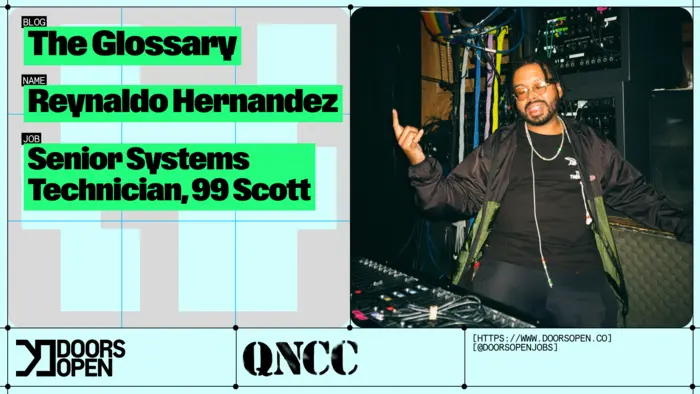
Introducing: Reynaldo Hernandez | Senior Systems Technician, 99 Scott
Rey aka BASSBEAR!! is a Bronx-born DJ, producer and sound engineer based in New York. He has performed at venues including Nowadays, Paragon, Elsewhere and Bossa Nova Civic Club, and co-produced Princess Nokia’s track “Brujas”.
His collaborators include DJ Swisha, Kush Jones, Moma Ready, Towhead Records, Splice and James Bangura of Black Rave Culture. Alongside his work as an artist, he has previously worked as a resident front-of-house sound engineer at Avant Gardner, as resident sound engineer at Webster Hall and currently is 99 Scott's Senior Systems Technician.
RA and Doors Open are partnering with New York's Queer Nightlife Community Center (QNCC) to host RA25 UNLOCKED: Expanding Careers in Nightlife with QNCC, a free, one-day programme focused on developing sustainable careers in nightlife.
Taking place at the East New York venue on October 15th, the event will feature workshops covering sound engineering, lighting design and event production, alongside discussions on career pathways, event safety and harm reduction.
The programme is aimed at local nightlife workers and community members from East New York and Brownsville looking to expand their skills and improve financial stability. Applications will prioritise groups including FLINTA individuals, LGBTQIA+ community members, disabled workers, lower-income applicants and residents of East New York and Brownsville.
Rey is next up in this special Glossary series introducing the speakers at our upcoming New York community event and exploring their careers in nightlife.
What is your role in music, and what does your day-to-day look like?
My current role in the music industry is audio systems engineer / technician at a music venue in Brooklyn, NY. My day-to-day tasks include the following responsibilities:
-
Production planning / management
-
Crew chief leadership during events
-
Audio systems design and deployment of speaker systems
-
Audio signal flow maintenance and processing (preshow)
-
Audio system operation (during events)
-
Primary role within the venue workspace as a systems technician
How did you get into your line of work?
I've been DJing for about half my lifetime now (currently 36 years old). This has been the fundamental starting point in my career. I developed a habit of being proactive about what a sound system should look and sound like for my shows, which led my interest into working in production sound. I've built my experience from the ground up, starting as a stagehand for live events and eventually moving up the ladder in the following order:
-
Stagehand / production assistant
-
Stage audio technician (patch tech/A3)
-
Audio monitor engineer (A2)
-
FOH audio engineer (A1)
-
Stage manager
-
Audio systems technician (supervisor)
What skills are important in your job?
I would say experience is overall a priority for the job. It can take several years (myself being 12 years professionally working) to gain the confidence to reach where I'm at today. Training and qualifications are vital to the experience; they go hand in hand, but I wouldn't put one over the other. One's experience essentially dictates how much training you need for your career to take its journey.
In my personal experience, I've had the opportunity to be mentored informally by someone who was working in the film industry as a location sound engineer. I've learned skill sets as a boom operator and a sound assistant for this person and eventually was able to take a lead role as a sound engineer for film. This experience was about two to three years, back in 2013. All of my "training" outside of being mentored was simply YouTube or reading material with on-the-job training.
Shortly after, I had the opportunity to work in live sound for events. Still no formal training, but the skills are transferable. After maybe five years working live sound, I made the decision to refine my skill set by taking a vocational course in sound engineering in 2018. This has given me an insane leap in confidence that I didn't have before, and has allowed me to gain large opportunities in the NYC nightlife scene.
Training is important for the job, as every job I've had has a different approach or application to complete the task. It has always been a habit to not only make sure you know what you're walking into, but also to constantly take refresher tasks to keep your skills sharp, especially if you're given a challenge to operate on a new platform. You must make it a priority to learn the tools you need for the job, whether it's YouTube, reading manuals, or taking a certification. It doesn't justify a pay increase, as most will think, but it secures your place in the workforce. It's a labor of love, and if you love it enough, the rewards are massive in many ways. An example of training modules I've taken in recent years consists of:
-
Dante Networking Certifications Level 1 and 2
-
Smaart Operator Certification Level 1
-
Audio signal flow (vocational study)
-
Mixing console operations (vocational study)
-
OSHA 30
-
Forklift operator certification and utility vehicle training (on-the-job training)
If someone is excited to do what you do, what advice would you give them?
Don't rush your journey. Don't rush the process. If you feel like you're not achieving your results or goals, slow down and reassess what you are doing or what you need to do to get there. Managing expectations is a hard reality to bear in the world of audio engineering creatively and professionally on the job.
What have you found surprising about your role?
-
It's simply not easy. It's a labor of love, and you need to have resilience in your passions and expectations.
-
Once you've built your fundamental skills, for the most part, it's not a rubric for your career, simply just a guideline. You'll realize that a lot of rules break in the process due to parameters and constraints. You have to make sure you always have the ability to be adaptable with your skills, goals, and techniques to get the job done.
-
The more honest you are about yourself and your ability, the easier it is to enforce the boundaries that are imposed upon you. Many times in my experience, I've been relied on to make do with what I have, afraid to speak out in fear of letting someone down on the job. You must relieve yourself of the pressure that it falls solely on your shoulders to get the job done. After all, it is a production, and it takes a lot more people than you think.
Don't Be a Hero, Be a Team Player
What are your top three tips for someone who wants to work in the music industry in general?
-
Always look out for your health when working.
-
Sleep is important; don't underestimate how much sleep you need when working long hours.
-
Wash your hands very often.
-
Wear protective gear if you know it's needed (gloves, safety glasses / sunglasses, suntan lotion, good shoes with non-slip / weather resistance, and durable clothing that doesn't rip easily).
-
Do not mix your work clothes with your regular clothes at home. That includes your shoes, work bag, and anything that touches work environments.
-
Always ask questions.
-
Know your worth.
Read more about RA25 UNLOCKED: Expanding Careers in Nightlife with QNCC and apply here.
Explore jobs in electronic music on Doors Open here.