The Glossary: Michelle Erfer | Booking Agent, The Bunker
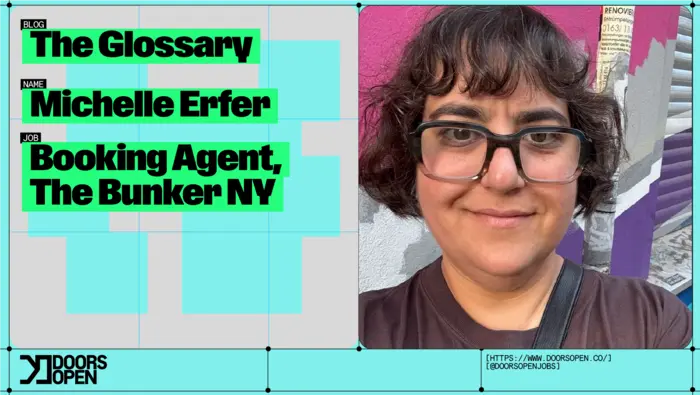
Michelle Erfer (she/her) is the Program Director of the Artist Representation program at Beyond Booking, The Bunker's in-house booking agency.
She is a cultural producer, music curator, and veteran booking agent with 10 years of international artist management experience (as well as being an author and non-profit administrator) who works at the intersections of music, future technology, art, holographics and computers, giving her the unique fluency to speak to both the creative and professional demands of our roster of artists.
We caught up with Michelle ahead of Doors Open UNLOCKED: Careers NYC to get her insights for the Glossary.
What is your role in music and what does your day to day look like?
I direct the Artist Representation Program at The Bunker NY/Beyond Booking, Inc, which has been a registered 501c3 nonprofit organization since 2012. To my knowledge, we are operating the only non-profit booking agency in the US. Unlike other booking agencies, the motive is not primarily to earn money for ourselves or any corporate entity and instead we work to maintain a sustainable organization with the capacity to support artists regardless of their profitability. We prioritize working with artists who are from historically resilient or underrepresented backgrounds and who possess a high level of skill and dedication to the craft of DJing and/or music production as well as those who are making meaningful contributions to the larger cultural landscape of electronic music.
My day consists of responding to booking requests, negotiating artist compensation, administrative tasks such as sending contracts and invoices and handling all of the logistics for the artists on my roster. I try my best to support the artists as they navigate a challenging industry and lifestyle. I also spend time on tasks related to the nonprofit organization, which include attending board meetings and looking over grant applications. I work with help from a part-time bookkeeper, a part-time assistant and a part-time data entry clerk.
How did you get into your line of work?
I have been going to The Bunker’s events in New York since they started in a basement in the Lower East Side in 2003 and I have known our founder Bryan Kasenic even longer than that. In 2016, he asked me to help out with event logistics, the record label, podcasting and promotion as well as responding to the booking requests that came in for the party residents which at the time included Bryan, Patrick Russell, Derek Plaslaiko and Mike Servito. It soon became obvious that I only had genuine interest in the Artist Representation work and once I began to focus on it, with Bryan’s support and mentorship, it snowballed rapidly, we formalized the Artist Representation program as a pillar of the organization’s mission and I am grateful to currently support 28 artists.
What skills are important in your job?
It’s important to be organized, punctual, precise, hard-working, honest and able to both admit mistakes and move on from them. Strong interpersonal skills go a long way in navigating the complexity of this ecosystem and its many unique individuals.
If someone is excited to do what you do, what advice would you give them?
It’s expected that most of us are passionate about this work but do not let your desires overtake your good sense or your internal moral compass. Nightlife can look very glamorous but this comes with long hours, financial precarity and a real lack of stability. It is important to be respectful and kind, consider the needs of others and also check in with yourself. Make sure that you feel a common sense of purpose with your colleagues. Also: get all financial agreements in writing and don’t be afraid to speak up and advocate for yourself.
What have you found surprising about your role?
The work never stops. This is a global industry and some weeks I’m working on East Coast, West Coast, EU and Asia time. But the flipside of this is my intense feeling of connection with global dance music underground communities. I am continually surprised by how much I respect and love my colleagues and am very happy to run into them at clubs and festivals all over the world. There are so many unique gems of humans that I would never in a million years have been fortunate to have in my life without my job. I am proud of how much we all accomplish given the scarcity of resources artists and music industry workers struggle with. It gives me hope along a number of vectors to see us turning straw into gold in so many different ways.
What are your top 3 tips for someone who wants work in the music industry in general?
-
Please prioritize your health. Make a habit of wearing hearing protection. Be very mindful about partying and substance use. If you worry that you are getting to a bad place with your well-being please reach out to a caring person in your life because mental health struggles are an occupational hazard in this industry. There are industry-specific initiatives and organizations available including MusiCares who offer online support groups for music workers.
-
Make sure you feel proud of the work you do and trust your instincts.
-
Get all financial agreements in writing! (It bears repeating).
Explore jobs in electronic music on Doors Open here!