The Glossary: Mel Uye-Parker | Music Producer & Ableton Certified Trainer
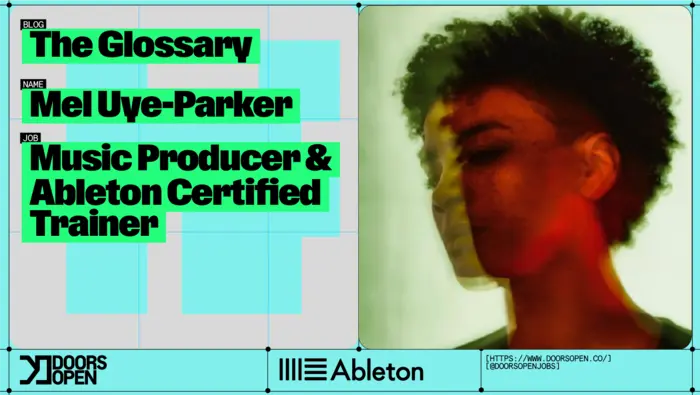
Our first run of 2026 Glossary interviews features the insights of workshop leaders and speakers from our recently announced programme - Doors Open UNLOCKED: Creating sound worlds with Ableton. You can read more about the programme and apply for a place here.
Mel Uye-Parker is a songwriter, vocalist, DJ, and electronic music producer from Nottingham, though she spent her formative years in Manchester immersed in both academic study and the city’s vibrant music scene. It was here she honed her distinctive fusion of soul, folk, and trip-hop, leading to collaborations with the likes of Yes King (BBE) and Rae & Christian (Late Night Tales). After relocating to London, Mel expanded into electronic music production under a number of monikers. In 2022, she recorded vocals for Musca (Accidental Records), the latest album by Matthew Herbert.
Mel is one half of House of Molly, the unapologetic, sleaze-soaked project formed with singer and writer RAHH. Their music is a celebration of blackness, queerness, hedonism, and everything the duo have ever agreed upon. With House of Molly, Mel has collaborated with Nicole Moudaber, Eats Everything, Perio Perupa, and Jamie Jones, releasing on Hot Creations, Higher Ground, Three Six Zero and their own imprint HOM Records. As a DJ, Mel brings the same bold, infectious energy to the booth, drawing together house, techno, and a twisted sense of disco.
Her other project, OMOTE, sees her collaborate with producer Cristiano Nicolini. Led by Mel’s sultry yet heartfelt vocals, the duo creates lush, textural soundscapes driven by hypnotic breakbeats and rolling basslines, exploring a more introspective, experimental side of her artistry. Mel also works as a freelance composer, recently collaborating with the charity In Place of War on a number of international projects with Indigenous artists.
Alongside her artistic work, Mel is an experienced music educator, lecturing at Berklee College of Music, Point Blank Music School, Guildhall School of Music & Drama, and most recently leading the Master’s in Creative Music Production at the Institute of Contemporary Music Performance. She is also an Ableton Certified Trainer and serves on the Board of Trustees for Create Define Release, a black-led, community-driven platform rooted in the UK underground music scene.
What is your role in music and what does your day to day look like?
I’m an artist, producer, DJ and educator, so my day to day is split between all of these. On the artist side (House of Molly), I’m usually writing and producing, rehearsing, prepping sets, or making content around releases and gigs. On the education side, I’m a Professor at Guildhall School of Music & Drama, as well as teaching private one-to-ones, mainly focusing on pop and electronic music production and composition.
A big part of the job is also admin: emails, social media planning, management meetings and mailouts. A typical day might look like teaching in the morning until around 1pm, then the afternoon being a mixture of studio work and admin. This week, for example, I’ve been finishing up a couple of track ideas we’ll be starting soon and pulling together tracks for a DJ stream and gig we’re doing at the end of the month.
How did you get into your line of work?
I got into it through generally being involved in music, playing in bands and writing for other people. Eventually I moved into production, and over time it grew into a mix of artist work and teaching. I started as a singer-songwriter, also writing toplines for more electronic projects, then moved into production mainly because I wanted more control over my sound. I was moving away from the folk-soul world and wanted a bit more energy and punch.
Teaching stemmed from my work as a workshop facilitator. I realised I really enjoyed it, so after finishing my music degree I enrolled on a PGCE in secondary music education and MSc in Educational Psychology and it developed from there. Both paths kept running alongside each other and now they feed into one another.
What skills are important in your job?
Creativity is obviously important, but so is flexibility, because it can be a very fragmented job. I’m also constantly developing my technical production skills, both to keep up with changing technology and to keep pace with my students, who definitely keep me on my toes.
You also need a lot of self-discipline. It’s easy to work on the fun parts, but you need the discipline to prioritise properly. I’m still working on that.
If someone is excited to do what you do, what advice would you give them?
My biggest advice is to remember, nurture and cherish that excitement, because both sides of my job come with challenges, mainly workload. Most musicians I know have day jobs, and although my roles feed each other, they can also get in the way of one another at times. It can be a difficult industry to navigate.
More tangible advice would be, on the artist side, to find people to work with who really get you and what you’re trying to do. Consider every opportunity with that in mind, because having that kind of support system is incredibly valuable. Also, get out and meet people, go to events even when you can’t really be bothered. I usually never regret going out. Something positive nearly always comes out of it down the line.
What have you found surprising about your role?
The most surprising thing is the number of different hats you have to wear. It’s not like you just spend years developing instrumental or production skills and then you’re set. There is always something new to learn. That’s what I love about being an artist. Everything you learn gets poured back into your art, your brand, or both.
At the moment I’m really enjoying learning more about graphic design and diving into After Effects, so some parts of the job start to feel like learning lots of new hobbies, if you can class marketing as a hobby!
What are your top 3 tips for someone who wants to work in the music industry in general?
Find ways to meet people and put yourself in slightly uncomfortable situations. That’s often where you make connections you wouldn’t otherwise make. This can also be online. Try to connect with artists who are at a similar stage to you. Offer to collaborate or simply cheer them on. Community can look different for everyone.
Make sure you take time to enjoy the process. It’s a lot of work and you really do have to wear many hats. In my experience it only gets more intense over time, so it helps if you enjoy most sides of it. That said, I’m not saying you have to love emails.
Have something else in your life. It’s very easy to become completely consumed by music and your projects, so it’s important to balance that out with other influences. For me, Tai Chi does that, but it could be any kind of practice. Just something that isn’t directly about making you better at music, although I’d argue Tai Chi still helps!
Apply for a place on our workshop series Doors Open UNLOCKED: Creating sound worlds with Ableton here.
Browse jobs in music on Doors Open here.