The Glossary: Katie Thomas | Senior Editor
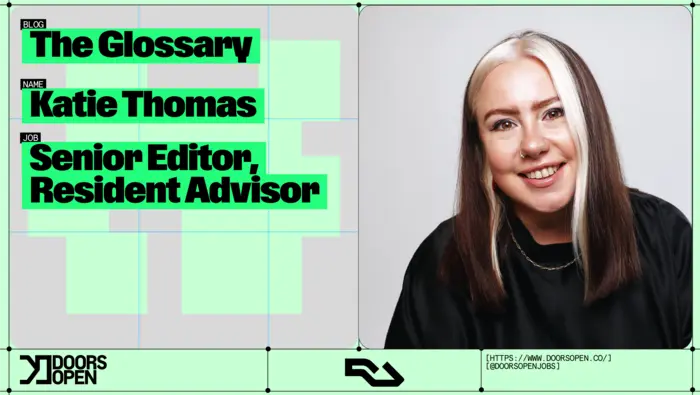
Katie Thomas is a London-based writer and editor specialising in music and culture. She’s currently a senior editor at Resident Advisor, overseeing the platform’s events coverage and branded editorial via the creative agency 23:59 (which is currently hiring a Media Partnerships Manager, read more and apply here!).
As a freelance journalist across print and digital, she's also written for publications such as The Face, DJ Mag, Dazed, Rolling Stone UK and Crack Magazine.
In May 2025, she launched My Mum Loved This Song on Substack, a series of conversations about music and grief raising money for Cancer Research UK.
We sat down with Katie, who took us through the ins and outs of her role within RA.
What is your role in music and what does your day to day look like?
I'm a Senior Editor at Resident Advisor and I lead on our events coverage and branded editorial. More broadly I am an editor, writer and general creative working across the editorial team and 23:59, our in-house studio through which we deliver brand partnerships.
Each day can be very different to the next, but the average might include a few meetings, editing or sub-editing features, commissioning upcoming pieces, brainstorming creative ideas for brand work, writing news and writing RA Picks. I'm blessed with sharp eyes so I also do a LOT of proofreading across the site and our socials. Then, of course, I'm always trying to listen to some new music and keep on top of my inboxes—which is a job in itself!
How did you get into your line of work?
I really went around the houses before ending up at RA. I went into this in more detail when former RA editor Todd L. Burns asked me to contribute to his Music Journalism Insider newsletter. You can read the full answer here. But the long and short of it is, I knew I wanted to work in music in some shape or form for a long time, but it never occurred to me that I could combine my love of music with my skill for words. As I'm sure many of you will relate, imposter syndrome is REAL, and the idea that anyone would be interested in reading what I thought about music just didn't even cross my mind.
I actually didn't publish any music writing until I was 25, after I was unceremoniously fired from a job I'd had in club promotions in 2016. I basically lost all my confidence and almost gave up hope on working in music at all, but when fabric lost its licence and I wrote about it on my old Blogspot, it ended up helping me get my first unpaid, and eventually paid, writing gigs. I started out writing for places like Pigeons & Planes, London in Stereo and Radar Radio (many will know about the demise of Radar, but the editors were very talented and helped me so much when I was starting out), and worked and worked to expand my portfolio. I spent a few years working various part-time jobs so I'd know my rent was paid, and used the rest of my time to read and write as much as I possibly could, send pitches and go to clubs. By the time I joined RA permanently in May 2022, my portfolio had grown to include bylines in publications like Crack, DJ Mag, The Face, Dazed, The Quietus, Mixmag and Rolling Stone UK. I also held the position of clubs & festivals editor at London in Stereo for a few years, which was invaluable as I was starting to hone my skills as an editor.
What skills are important in your job?
Being professional. This is a world where it's so easy for the lines to get blurred between work and play, but time management, organisation and good communication will get you far. Being a writer, especially a freelance writer, requires a level of resilience. Not hearing back on pitches, or having them rejected, can knock your confidence, but use any feedback you get to make your pitches air-tight and laser-focused. You should also be responsive, receptive to feedback and punctual with your deadlines—all attributes that will make editors want to work with you again.
You don't need specific qualifications to do my job. A degree in journalism would of course be beneficial, for example having a solid education in journalistic best practices, ethics and media law, but it's by no means essential to do what I do.
Beyond the obvious fact that you need to live and breathe music, I think the most essential components to succeed in a role like mine is a passion for the written word and storytelling, plus a meticulous attention to detail. In this day and age, it's also important to think about how a story can be told across a publication's many platforms, so having a creative vision beyond the page can be really helpful.
If someone is excited to do what you do, what advice would you give them?
It's never too early to start building a portfolio. Start writing about the tunes you like, the shows you go to, the latest unhinged online discourse you see, keep a diary, write stories—whatever piques your interest. I would really encourage you to always read your work aloud, this will help you find your voice and structure your writing in a way that is smooth, digestible and playful when the idea allows.
And also, read! Nothing will help your writing as much as reading, reading and reading some more. That doesn't just mean music writing either, nor should it be exclusive to things you think you are interested in. Getting stuck into niche longform writing will help you find the hooks, styles and narrative structures that keep you on the page. A good story will keep the reader—whose attention is increasingly fleeting these days—on the page right until the end, so think about what it is that keeps you on the page.
When I was first getting into writing for RA, our managing editor Carlos Hawthorn recommended two books to me: On Writing Well by William Zinsser and Elements of Style by Richard De A'Morelli. Add both of those to your pile! And thinking about my previous answer, you could refer to The New York Times, the Guardian, National Union of Journalists and the Independent Press Standards Organisation who all have helpful resources, guidelines and codes of practice for journalism.
It's a very challenging time for music journalism, which means it's also a very difficult time for freelancers and there are fewer in-house roles than ever before. If you're pitching to a publication, think carefully about who you're pitching it to and why. Why is this particular story right for this particular editor at this particular publication? Know what the editor is into and where your idea would sit within what the publication has been putting out recently. The more focused your pitch, the more likely you are to end up with a successful commission.
What have you found surprising about your role?
Honestly, it's that I don't get to write as much anymore. It's not that surprising really, but I hadn't really thought about the fact that the more senior you become as an editor, the less time you have for writing. It makes sense though—our time is finite—and I think this is something you'd find in many other jobs, in that the more senior you are, the less time you have for the thing you started off doing.
Connected to that, I admit I was also surprised by the amount of project management and strategising that goes into the day-to-day of a publication. Again maybe that seems obvious, but when you've been a freelancer for a long time, there's not so much to take into consideration about how each piece fits into the much bigger jigsaw that is the editorial team, within a department, within a company. There are so many plates spinning all the time and it requires some serious juggling and organisation to keep everything ticking over. This goes back to what I was saying before—being highly proficient in things like communication and time management are so key!
What are your top three tips for someone who wants to work in the music industry in general?
This isn't for the faint-hearted, so I'd say you need to have a love for music that runs through your veins. Think about your skill set and what you love, and then find your niche.
Don't be afraid to ask for help—got a writer you admire or someone whose job you're really interested to learn about? Tell them! Ask them for advice. Find a mentor. I had so many people help me along the way so I feel a responsibility to pay it forward and I hope most of us feel the same. On that note, please feel free to reach out for help with anything I've talked about here. My contact info is on my website: www.kthomas.co.uk.
Finally, this is the fun (and obvious) one: Listen to music and go out and dance! Go to small parties, big parties, gigs, festivals, go to whatever you feasibly can. Listen to music, read newsletters, get lost in black holes on SoundCloud or Bandcamp, stay up to date with your favourite publications, be immersed in this thing that you love and that way you will gain and retain an understanding of what is bubbling away and most importantly, what's exciting you.
Feeling inspired? Explore jobs in electronic music on Doors Open here.
Apply for the Media Partnerships Manager role at 23:59 here.