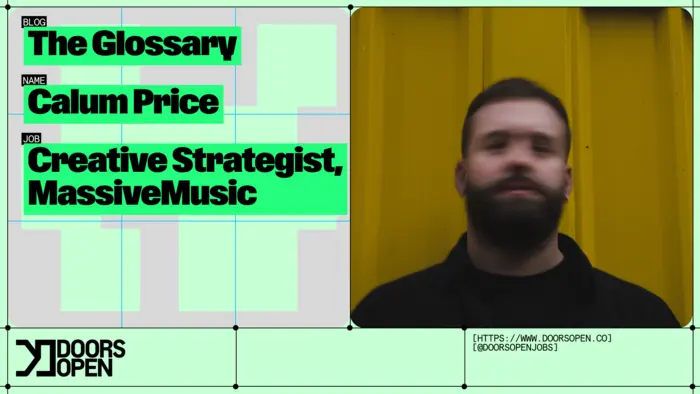
The Glossary: Calum Price | Creative Strategist, MassiveMusic
What is your role in music and what does your day to day look like?
I'm a Creative Strategist at MassiveMusic, working primarily in Advertising & Sonic Branding with brands like McDonald’s, Dove and Vodafone and agencies like Leo Burnett, Ogilvy and Wieden+Kennedy.
My role sits at the intersection of music, sound, culture, and technology. Day to day, I work across sonic branding, advertising and music strategy projects for brands and agencies. In practice, that means I might be translating a brand's positioning into a sonic identity, creating a sonic logo, or suite of brand owned sounds that feed into a wider sonic ecosystem, crafting the sound of a campaign, developing music strategies to be more consistent across their touchpoints, and building generative music tools that create sound experiences in innovative ways. Or I could be reviewing production assets with composers, giving feedback on demos, listening to music that could be the right fit or building out a pitch deck for a new business opportunity. A big part of my role is also making the creative case for why a particular musical direction is right for a brand.
My day honestly changes from one to the next, no two are ever the same, and it's one of the things I love about this industry. Some days I'm working with teams to map out the landscape a brand is playing in: who their competitors are, how they currently use sound, and what tensions exist that music could resolve. Other days I'm deep in ideation sessions, finding new ways a brand can show up sonically, or in the room with agencies, artists and producers crafting the actual assets - the music used on campaigns, the tools that expand a brand's sonic world into physical spaces. There's also a lot of presenting and pitching, working with internal stakeholders to understand who a brand really is and how sound can enhance that. I'm lucky enough that we get invited to gigs, screenings, and events so there’s usually some networking and getting out there too.
How did you get into your line of work?
I DJ and produce techno under the moniker Royal Sun and I wanted to make sure that whatever I did in my working day stemmed from a passion for creativity. I started my career in sync, in Music Supervision & Production for advertising, that's where I learnt the craft of placing music to moving image and defining the sound of a campaign. I wanted to think more broadly about the overall sound of brands, how music, sound and technology can come together to connect with an audience and how brands can do that more effectively in culture.
My first role was at Sony Music Publishing in their KPM team working as a Junior Creative Sync, pitching the catalogue. I then moved to Big Sync, starting as Music Co-Ordinator and moving up to Music Supervisor, searching for and licensing everything from library tracks to big commercial licences, working with composers to create original compositions and re-records of famous tracks, and working with labels and publishers. Big Sync (now MassiveMusic) is the global music partner to Unilever, so I was very lucky to be exposed to global campaigns and brands. This is where I started working on Sonic Branding projects. As soon as I discovered that translating a brand into sound, building its narrative, thinking creatively about how it connects with people, was an actual job, I was obsessed.
My move to becoming a Creative Strategist definitely didn't happen overnight. It took a lot of banging on doors trying to make things happen, dealing with rejections and being vocal about a passion for creativity in sound. Being in a fully creative role was a dream and I'm incredibly lucky I get to do this for a job, and work alongside amazingly talented people.
What skills are important in your job?
Before moving into music I completed a Masters in Audio Production, looking primarily at spatial audio and music for film, learning tools like MaxMSP, how audio can be used outside of a stereo mix to immerse audiences and how a user can move around a sonic environment. This has been invaluable because it means I have a pretty good practical understanding when we’re collaborating with developers or sound artists of the tools they use, particularly on the more generative side. It’s definitely not a prerequisite to getting a job in music or sonic branding though.
Honestly, there’s no one qualification, experience or training, but I think a good understanding of music production, music culture and the advertising and branding landscapes are pretty essential. Also, an understanding of how brands build strategies is key. You also need to know the practicalities of using music, and engaging with artists, labels and publishers.
More broadly, the music industry is absolutely relationship-driven, it’s built on that, so I think being able to collaborate, be approachable and know how to network in a way that doesn't feel transactional is important. Essentially if your approach can be ‘what can I do to help better the industry or the work’ rather than just ‘what’s in it for me’ you’re on to a good thing.
If someone is excited to do what you do, what advice would you give them?
Everyone’s journey into this is different and there’s honestly no right or wrong way. My advice would be to focus and just go get after it. You’re more than likely going to get setbacks, dealing with rejections and people not getting back to you. I definitely did and it’s very easy to internalise that and think for whatever reason it’s you that isn’t right for it and that other people are better or that you just don’t fit in and it will never happen. Fuck that, if you want to achieve something and you’re passionate, you care genuinely about creativity then ignore the noise and move forward. Don’t be afraid to go outside your comfort zone, this is often where the most interesting work lies.
There were times when I thought it was never going to happen and honestly if you’d told me when I was trying to get into the industry that I would be writing this article I wouldn’t have believed you, it’s mental. Passion, dedication and persistence really do matter. It’s never too late to go after it, no matter where you think you are in your life, age, location, whatever, if you believe in something go do it.
Soak up all you can, immerse yourself in music, technology and culture, the interesting work, who’s creating it, who’s innovating and who is moving the industry forward, get obsessed with it and don’t stop.
What have you found surprising about your role?
It’s mad, when I was trying to get into this industry I thought that having a creative role would in some way validate me, but the truth is it never comes. You just move on to the next ambition, progression or focus and that comes with a whole different set of anxieties.
I definitely struggle with imposter syndrome, it’s so real, but as much as you can, you have to use it in a way that drives you. I use it to make sure I’m always striving to create the best work possible, to never settle with mediocrity, to constantly keep moving. It’s easy to feel like you don’t deserve a seat at the table. As much as I can, I try to remind myself that my perspective, opinion or point of view is as valid as anyone else's, but it’s a constant work in progress.
What are your top 3 tips for someone who wants work in the music industry in general?
You’ve got to back yourself, there’s no one out there who’s going to give it to you so be confident and apply yourself to the best of your abilities. Persistence really does pay off, rejection, not hearing back, is all part of the process, whether it takes a year or several, just go do it. There are sacrifices along the way but if you genuinely want a creative career only you can make that happen.
Be passionate about what you do, care about the work, care about the industry, care about the people who create it. It’s a privilege to get to work in this industry, don’t take it for granted, be excited, we’re living through very mad times, but good art and creativity come from that.
There's no such thing as a dead end job, a mate of mine said that to me once and it really stuck with me. It's so true. Whilst studying for my masters I took a part time job completely unrelated to sync, that led to my first role in the music industry, which then opened the door to where I actually wanted to be. You gain experience and insight from the most unexpected places. Be open to the world around you and don't view progression in a linear sense. The most exciting opportunities often come from the unexpected.
Explore jobs in electronic music on Doors Open here.