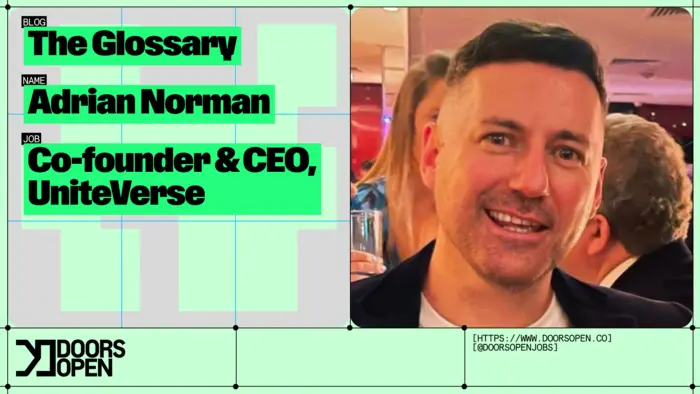
The Glossary: Adrian Norman | Co-founder & CEO, UniteVerse
What is your role in music and what does your day to day look like?
I wear a few hats in music, which is probably quite typical of the industry.
I work with Music Venue Trust as Financial Controller, having first come across their fantastic work supporting grassroots music venues during the pandemic. I now support the organisation behind the scenes across finance, people and operations. I also manage and develop emerging artist ROZZZQWEEN, so I see the industry from the other side too - from budgets and contracts to releases, marketing, branding, touring, funding and career strategy.
Alongside that, I'm Founder of UniteVerse, a technology company using AI and data to help venues and cultural spaces better understand their audiences, particularly around safety, accessibility, inclusion and experience.
So there isn't really a typical day. I can go from a finance meeting to discussing an artist's next release, reviewing a contract, working through a problem to find a solution, or talking about how AI and data could help the cultural sector make better decisions.
That's one of the things I love about music: there are hundreds of careers behind what happens on stage.
How did you get into your line of work?
Definitely not through the traditional route.
I left school at 16, state-educated and from a low-income background, without a degree or the networks that can open doors. I went into finance and built a career of nearly 30 years, progressing into senior roles in an industry where people from backgrounds like mine were often underrepresented.
I've experienced adversity, bullying and being underestimated along the way. I've also often approached environments and problems differently. Over time, I've realised those experiences shaped how I lead, how I understand people and why creating opportunities for people who might otherwise be overlooked matters so much to me.
Music didn't happen overnight. It really started to become part of my professional life when I moved to London. I began working in artist management alongside my day job, learning the industry by doing it - evenings, weekends, building relationships, going to events, doing courses, putting on events, helping artists and gradually understanding management, contracts, releases, touring, funding and all the difficult bits nobody necessarily sees.
You have to hustle. Opportunities don't always arrive neatly packaged, particularly if you don't start with connections or an obvious route into the industry. I've always believed that, while we can't control where we start or everything that happens to us, we have to take responsibility for creating our own opportunities and shaping our own destiny.
Eventually the different parts of my life connected. I realised music doesn't only need people from traditionally “creative” backgrounds. It needs people who understand finance, technology, business and people - and people with different lived experiences.
UniteVerse grew from that too. From my own lived experience, and the way I naturally analyse and see the world, I became fascinated by what traditional data misses – the people hidden by averages, the patterns we don't connect and the experiences we don't see. That became Cultural Intelligence: using data and AI to help physical spaces understand people better and turn insight into positive change.
UniteVerse wasn't born because I wanted to build a tech company. It was born because I kept seeing things that the data didn't.
Today I've brought those worlds together: music, finance, technology, people and entrepreneurship.
My route wasn't linear, and that's exactly why I share it. You don't need to have studied music, gone to university or known at 18 what you wanted to do.
Where you start doesn't determine where you finish. Sometimes you have to create the door you want to walk through.
What skills are important in your job?
Curiosity, the ability to think on your feet, determination and energy are important.
You need to be willing to learn constantly because the industry changes incredibly quickly.
Financial literacy and commercial understanding are obviously important in my roles, but the soft skills matter just as much: communication, empathy, negotiation, problem-solving and being able to work with very different personalities.
You also need resilience. Music can be unpredictable and there will always be setbacks.
I'm a big believer in transferable skills. You don't necessarily need a music-industry qualification. Finance, technology, hospitality, marketing, law, data, operations, HR and countless other backgrounds can all lead into music.
And increasingly, understanding data and AI will matter. Not because technology replaces people, but because people who understand how to use technology intelligently will have powerful new tools.
Above everything else: be interested in people and community. Music is ultimately a people business.
If someone is excited to do what you do, what advice would you give them?
Don't wait for permission to start.
You don't need to know everything before you enter the industry. I certainly didn't.
Learn how the business actually works. Understand where money comes from and where it goes. Learn about copyright, royalties, live music, publishing, recording, contracts and the organisations behind the industry.
Then get involved.
Volunteer. Help an artist. Work with a venue. Attend industry events. Ask questions. Meet people. If you see a problem nobody is solving, try solving it.
And don't assume your background excludes you.
I left school at 16 and came into music after building an entirely different career. Some of the experience I once thought was unrelated became incredibly useful.
Your unconventional route can become your advantage.
What have you found surprising about your role?
How much of the music industry has absolutely nothing to do with making music.
Behind one artist walking onto a stage can be managers, agents, promoters, venue teams, accountants, lawyers, production crews, marketers, distributors, publishers, funders, data specialists and countless others.
I've also been surprised by how much of the industry still relies on relationships, instinct and fragmented information.
That's partly what led me into building UniteVerse. We generate enormous amounts of information about audiences and cultural spaces, but we don't always turn it into intelligence that helps people make better decisions.
And perhaps the biggest surprise is that there is no single route into music. Some of the most interesting people I've met arrived from completely different industries.
What are your top 3 tips for someone who wants work in the music industry in general?
1. Get in the room.
Go to gigs, conferences, networking events and industry sessions. Talk to people and ask questions. Relationships matter enormously – but genuine relationships, not just collecting contacts. You'll also learn more from people and their experiences than you will almost anywhere else. That's life.
2. Understand the business, not just the music.
Learn how the ecosystem works — how artists, promoters, venues and organisations actually survive. Understand money, rights, contracts, audiences and data. The more you understand, the more valuable you become, and the more lightbulb moments you'll have. Don't forget: things change faster than ever before.
3. Don't let your background decide whether you belong.
You don't need the perfect degree, connections or a conventional career path. Given my own background, I came into music through finance and entrepreneurship. Bring the skills, experiences and perspective you already have.
The music industry doesn't just need more people who know the industry. It needs people who see it differently - and genuinely care.
Explore jobs in electronic music on Doors Open here.