Doors Open UNLOCKED: Pathways into the Music Industry at Dekmantel
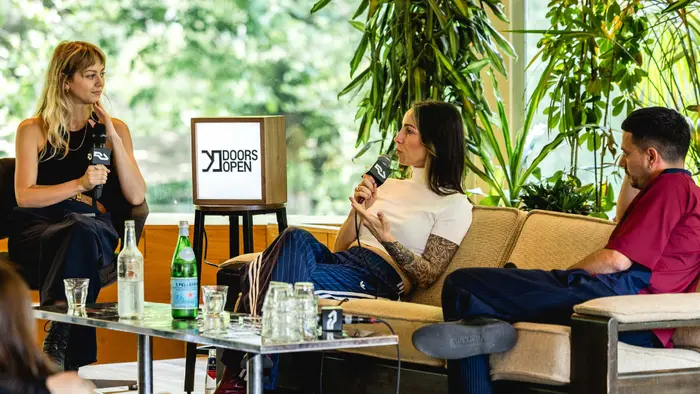
During Dekmantel Festival in August, Doors Open hosted a panel discussion with Katty Lange, booking agent, artist manager, and co-founder of Triangle Agency, and David Cornelissen, Dekmantel’s Head of Creative. In this one hour conversation, they shared insights into what a workday looks like in their roles, how their collaborative process as agent and promoter works, their own career paths, and some of the lessons they learned along the way.
Jasmín Hoek recounts the key takeaways of the day for Doors Open.
The Day to Day
Katty Lange, booking agent, artist manager, and co-founder of Triangle Agency, describes her work as fluid and communication-heavy. “I strategise and I communicate between promoters, artists, and every day has a new strategy. In our job no day is like the other.” Her responsibilities range from managing logistics on international tours to translating her artists’ creative visions into actionable plans. “I take the artist’s idea and try to formulate it in a way that we can make it possible, and understandable for a promoter we think would be the right partner for a project,” she explains. “Not everything is made for everywhere. So let’s say we have an idea. I’ll go and see strategically in which city it can be performed, and then I find the right partner locally. A promoter has to understand the idea, but we also work together with them because they know the dynamics, demographics, and the city they’re based in. and then we see if they already have an existing venue, or if we have to find other venues, and then we work on a budget. We work on making it happen together.”
Meanwhile, David Cornelissen, Head of Creative at Dekmantel, oversees programming, partnerships, communications, and branding. “I just make sure all parts of Dekmantel understand each other,” he says, describing his role as a form of creative management. His day-to-day shifts with the seasons: “Now, so close to the festival, it’s a lot of communication. During the winter, more editorial or the label. The programming starts again the week after the festival.” He coordinates across teams to maintain coherence in Dekmantel’s evolving identity, and protect the core values and what distinguishes the organisation in the competitive Dutch festival landscape.
The collaboration of an agency and a festival organiser in action
Katty and David often work closely when it comes to artist bookings, but that process is never straightforward. “Quite often the initial idea usually doesn’t end up being the final one,” says David. Before approaching Katty, Dekmantel’s internal team undergoes months of planning and strategising through daily meetings with the team involved in the bookings: “It takes at least two months to get to version one of Dekmantel Festival. We do three festivals, and work on booking all three of them at the same time; between September and Christmas.”
For Katty, each booking request is carefully evaluated: “Generally, the first thought is what are an artist’s plans for that city or region for the next year. It depends on the artist’s size, because sometimes I’d need to make sure they don’t play the same city right before or right after. We need to have an understanding of the festival musically: the direction, the stages, and the idea of the stage where the artist is requested. Usually a festival reaches out with an idea already, then it’s my responsibility whether this is good or not, in case we wanted to see the artist somewhere else, we’d have to explain that through the artist’s profile, their development. If a festival is booked in September, maybe by next August everything will be different. An artist might have a release or a tour coming. So I’ll start discussing with the promoter, negotiating creatively.”
David: “We indeed always look at future plans as well. Sometimes we fly out to some of the major cities where agents are based, and discuss what their artists’ plans are before we start reaching out. We take it into account when deciding where we think artists could be best placed. Something like an album coming out is always really exciting, and can impact our decision making.”
Both stress the importance of expectation management through transparency in the communication between promoter, agent, and artist. “Transparency between the agent and the artist is really important,” Katty says. “Be clear and don’t promise something that’s not contracted or confirmed yet. You can say we’re in conversation or a promoter has shown interest, but there’s no guarantee. It doesn’t mean anything is happening right now, it just means the promoter has the artists on their radar.” Sometimes an artist does say no to something she has been working on as an agent for months. “Communication is key, if you communicate constantly it’s more likely that you will already know if it’s something that they'd like to do. Same goes from the artist’s side; communicate if there's a different commitment that day.”
Same goes for David, who tries to be transparent to manage expectations of an artist they’d potentially want to book. However, the plans for the festival can still change within the booking process. “Let's say an option has been pencilled in an artist’s agenda for one of our festivals, and they’d really want to play, it is our responsibility to be very clear and transparent that it's still an option. Otherwise we raise expectations, and it can feel quite negative when it doesn’t happen.”
It also happens the other way around according to David, where plans the Dekmantel team had sometimes don’t work out. “I could lay awake if something that I really wanted wouldn't happen. We also get told no sometimes,” he says. “You have to learn not to take things personally, and deal with disappointment on all sides of this process.”
Insights from their paths and advice for the next generation
Both David and Katty found their way to their current music industry position working many different jobs purely out of passion for music and club culture initially. From getting a foot in the door by working at Amsterdam club Trouw’s restaurant (David) to doing an internship at a record store (Katty), their careers shaped organically through different jobs and positions.
Both Katty and David express the importance for their growth through gathering experience from all sides of the industry. Especially for communication and emphasising with the people you work with. “It’s important to realise that the scene is not that glamorous as it might seem,” David says, “in the end it’s people working together.”
Katty urges newcomers to explore all corners of the industry. “Everybody in a club, from a runner, to a person at the wardrobe, is as important as everybody else. If you show dedication, and don’t feel too good for a certain job, you have the best chance to grow. Throughout my career it was never like ‘here’s my application’, it all happened more organically. I still think this is the way it happens. It’s about showing passion, understanding, vision, and determination.”
“It’s about being persistent and present,” David recalls. “You need to have a certain level of passion, because it’s going to take a while until you get to a position you want, and you might think you’re already ready for. I’m happy with where I am now, and all the experiences I gained along the way now, but it took me a while to figure it out. It takes time to figure out how to do things properly. You have to step up for yourself, vocalise what you want, and try to make yourself seen. That calls for persistence.”
Explore jobs in electronic music on Doors Open here.